The futuristic robots are a long way from the operating room. But a fantastic voyage might come sooner than expected.
By David Grossman
May 28, 2019
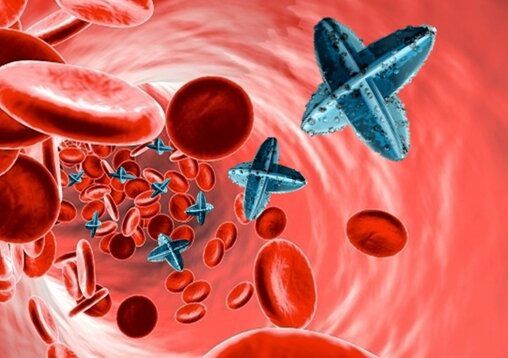
The sci-fi sub-genre of body-shrinking adventures could soon turn from fiction into reality. Engineers at the University of New South Wales (UNSW) in Australia have developed micro-submarines powered by nano-motors that can navigate through the human body to deliver medicine to diseased organs without surgery.
“We already know that micro-motors use different external driving forces—such as light, heat, or magnetic field—to actively navigate to a specific location,” says Dr. Kang Liang, of both the School of Biomedical Engineering and School of Chemical Engineering at UNSW, in a press statement. “In this research, we designed micro-motors that no longer rely on external manipulation to navigate to a specific location. Instead, they take advantage of variations in biological environments to automatically navigate themselves.”
For anyone looking to make a map, the body has a number of touch points that could act as guides. For Liang’s team, this meant looking at the body’s pH levels. Human bodies are mostly water-based, after all, and the body expends a considerable amount of energy, keeping those pH levels within a healthy range. The micro-machines would self-adjust their pH levels to maintain their buoyancy as they move through the body.
“Most micro-motors travel in a two-dimensional fashion,” says Liang. “But in this work, we designed a vertical direction mechanism. We combined these two concepts to come up with a design of autonomous micro-motors that move in a 3D fashion. This will enable their ultimate use as smart drug delivery vehicles in the future.”
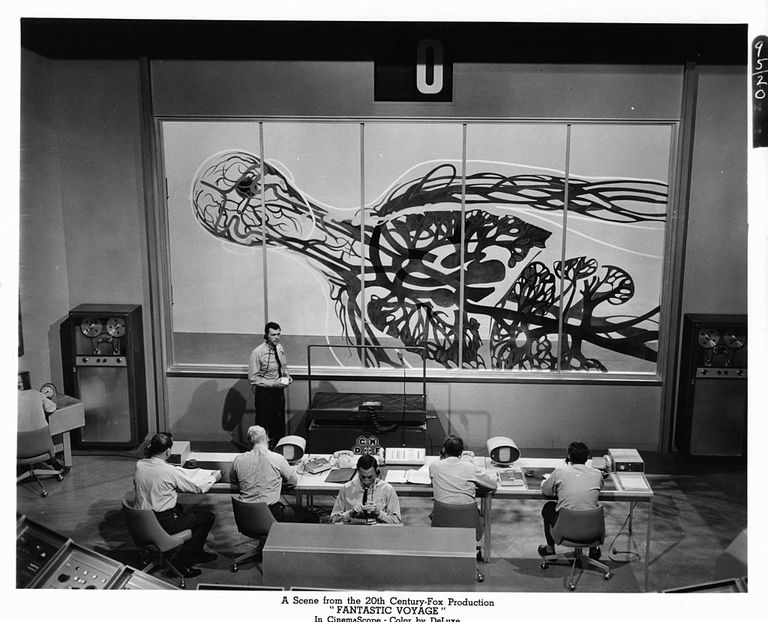
A still from the 1966 film Fantastic Voyage. While sharing a concept, Dr. Liang’s submarines would look and function very differently.20TH CENTURY-FOX/GETTY IMAGESGETTY IMAGES
In the 1966 flick Fantastic Voyage, a submarine crew enters a human body to remove a blood clot. Liang’s robots, meanwhile, move in controlled swarms. In a future imagined by Liang’s team at UNSW, a pill could potentially hold millions of micro-machines. Each of those machines, in turn, would hold millions of drug molecules. Together, they would combine for an effective treatment.
“Once in the gastrointestinal fluid, the micro-submarines carrying the medicine could be released,” says Liang. “Within the fluid, they could travel to the upper or bottom region depending on the orientation of the patient. The drug-loaded particles can then be internalized by the cells at the site of the cancer. Once inside the cells, they will be degraded causing the release of the drugs to fight the cancer in a very targeted and efficient way.”
These micro-machines are still in the proof of concept phase. But physically, they would be metal-organic frameworks with micro-motor systems holding a bioactive enzyme known as catalase. Normally, catalase is one of the most efficient enzymes in the human body, capable of decomposing of millions of hydrogen peroxide molecules every second. Within the micro-submarines, catalase would act as an engine of sorts for gas bubble generation.
“We are planning to apply this new finding to other types of nanoparticles to prove the versatility of this technique,” Liang says.
Tiny robots moving through bodies is still a long way from reality. But just like with space travel, it appears to be getting closer.







 Family Dragon Hot Pop